

That letter in your data mailbox
Did a message from the Financial Administration (Finanční správa) just land in your data mailbox (datová schránka)? Two attachments, both in Czech, both about something called EET 2.0?
Don’t panic. You are not in trouble and nobody is checking you.
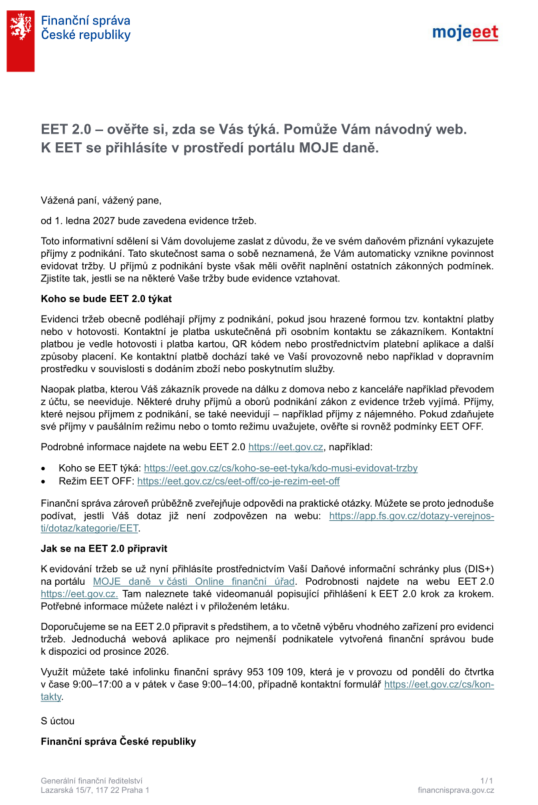
The tax office is sending this letter to everyone who reported business income in their tax return. That’s basically every freelancer (OSVČ) in Czechia. The letter itself says it clearly: getting it does not automatically mean EET applies to you. It means you now have to check whether it does.
And that check is exactly where people get it wrong. Some ignore the letter because “I only invoice, this isn’t for me.” Others rush to buy a cash register they don’t need. Both can cost you.
I’ve been a certified tax advisor in Czechia for over 10 years, and I’ve already written about EET 2.0 here. This article is the quick, updated version for anyone holding that letter right now and wondering what to do with it.
What is EET 2.0, in one breath
EET stands for electronic registration of sales (elektronická evidence tržeb). From 1 January 2027, certain payments you receive as a business must be sent to the tax office electronically at the moment you get paid.
If you lived here before 2020, you may remember the first EET. Version 2.0 is its comeback, with new rules. And the biggest change is this: it’s no longer only about cash.
Who has to record sales
A payment has to be recorded in EET only if all three are true:
- It is business income (from your trade license activity).
- It is paid in cash or as a contact payment.
- No legal exemption applies to it.
If even one condition is missing, the payment stays out of EET.
The tricky part is point 2. A contact payment is any payment that happens while you and your customer are in person, or at your premises or in your vehicle. And it doesn’t matter how they pay. Card, QR code, phone app, even a bank transfer sent while they stand in front of you: all of these count. Cash counts always, even when you never meet the customer.
What stays out is a payment your customer makes remotely, from home or their office. Classic example: you send an invoice and the client pays it by bank transfer later. Same for payment gateways and QR codes on an e-shop website.
Situation | Recorded in EET? |
|---|---|
Client pays your invoice by bank transfer from their office | No |
Customer pays through the payment gateway on your website | No |
Client pays by card on your terminal after a session with you | Yes |
Customer scans your QR code and pays while standing at your stall | Yes |
Someone hands you cash, anywhere | Yes |
So the yoga teacher, the hairdresser, the massage therapist, the tutor who gets paid at the end of the lesson, the market seller: this is very likely you. The IT freelancer who only invoices foreign companies: very likely not. But “very likely” is not the same as “checked”.
Who is out
Not every income is business income. These are not recorded in EET:
- salary from your employer
- rental income (renting out your flat long-term)
- capital income and occasional sales, like selling extra fruit from your garden
- a truly one off payment that your normal business model doesn’t count on (if it repeats, even rarely, it’s not one off)
The law also exempts some specific activities and types of businesses, for example banks and insurers, public toilets, vending machines (under conditions), and some transport and postal services. The full list is on the official EET 2.0 website. For most freelancers, though, none of these special exemptions will apply.
One note for expats: EET covers only sales made in the Czech Republic.
On flat tax? Read this part twice
If you use the flat tax regime (paušální daň), the letter specifically tells you to check EET OFF. This is a way to skip recording sales completely. You pay for it with a surcharge of CZK 1,400 per month on top of your normal flat tax payment.
You can use EET OFF only if all of this is true:
- you are in the first band of the flat tax regime
- your self employment income in the previous year was not more than CZK 1 million
- you actively sign up by the deadline
And here is the part that worries me most. For 2027, the deadline to sign up is 11 January 2027. Miss it, and the notification is invalid. You can’t fix it later. You are then stuck with EET for the whole of 2027.
If you’re already in the flat tax regime, you file a separate notification. If you’re entering the flat tax regime for 2027, you tick the EET OFF option directly in your flat tax entry notification, which has the same deadline. If you have a data mailbox, you must file electronically.
Once you’re in, you’re in for the whole year. You can leave EET OFF only from the start of the next year. And if your income goes over CZK 1 million during the year, you keep paying the surcharge until December and start recording sales from the next January.
Is CZK 16,800 a year worth it for you? That depends on how many in person payments you get and how much the setup would cost you. There’s no one answer for everyone, and that’s exactly the kind of decision worth making with real numbers, not a gut feeling.
What to do and when
Date | What happens |
|---|---|
1 November 2026 | You can already activate EET in your DIS+ tax portal |
December 2026 | The free MOJE eet web app for the smallest businesses goes live |
1 January 2027 | EET 2.0 starts |
11 January 2027 | Last day to sign up for EET OFF for 2027 |
Step 0: Decide if EET applies to you at all. Go through the three conditions above. If you’re on flat tax, decide about EET OFF before 11 January.
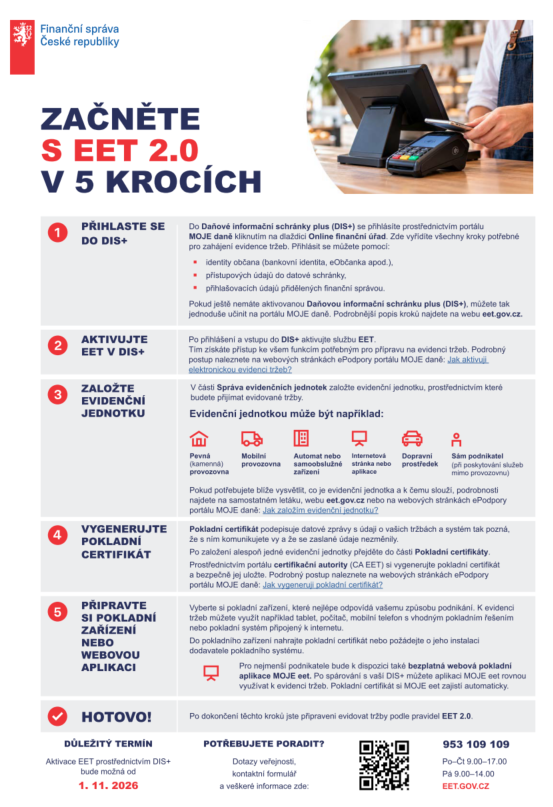
If EET does apply, the tax office lists five steps:
- Log in to DIS+ (Daňová informační schránka plus) through the MOJE daně portal, tile Online finanční úřad. You can log in with your bank identity, eObčanka, or your data mailbox login. No DIS+ yet? You can activate it there.
- Activate the EET service inside DIS+.
- Create a registration unit (evidenční jednotka). This is the “place” where you take payments: your shop, a mobile stall, your car, your website, or just you, when you provide services outside any premises.
- Generate a cash register certificate (pokladní certifikát) and store it safely. It signs the data you send, so the system knows it’s really you.
- Set up your device. That can be a tablet, computer, phone or till system with a suitable app. Or use the free MOJE eet web app from the tax office, which gets the certificate for you automatically.
Don’t leave this for the last week of December. If something doesn’t work, the tax office helpline will be busy exactly then.
Four things people get wrong
“I got the letter, so I must register.” No. Everyone with business income got it. It’s a reminder to check, not an order.
“I don’t take cash, so EET isn’t for me.” Careful. Card, QR code and app payments made in person count too.
“I’m on flat tax, so I’m automatically out.” No. EET OFF is not automatic. You have to sign up, pay the surcharge, and meet the conditions.
“I’ll sort it out in January.” If you want EET OFF for 2027, January 11 is the hard stop. One day late and it’s too late for the whole year.
Not sure where you stand?
That letter is the tax office telling you: “check yourself.” Most people won’t, until January.
If you’re not sure whether your payments count, or whether EET OFF pays off for you, book a consultation with me. We’ll look at how you actually get paid and decide in one call, well before 11 January. Book here or write to sarka@expat-tax.cz.
Never logged in to DIS+ before? Grab my free DIS+ guide first. You’ll need DIS+ for EET either way. Get the guide.
Still deciding between flat tax and the standard regime for 2027? My Czech Freelancer Starter Kit walks you through that choice, so you don’t pick the wrong one for the next year. Get the Kit.
And if you want deadlines like this one in your inbox before they hit, join my free newsletter. Sign up.
This article reflects the rules as of 10 November 2026. Tax office helpline: 953 109 109.